Saturday, April 5, 2008
Pharma Drug Rep Tells All
Ex-Drug Sales Rep Tells All
Former Eli Lilly Rep Says He Wined and Dined Doctors to Make a Sale
By MARCUS BARAM
—
To sell their drugs, pharmaceutical companies hire former cheerleaders and ex-models to wine and dine doctors, exaggerate the drug's benefits and underplay their side-effects, a former sales rep told a Congressional committee this morning.
Shahram Ahari, who spent two years selling Prozac and Zypraxa for Eli Lily, told a Senate Aging Committee chaired by Sen. Herb Kohl, D-Wisc., that his job involved "rewarding physicians with gifts and attention for their allegiance to your product and company despite what may be ethically appropriate."
Ahari claims that drug companies like hiring former cheerleaders and ex-models, as well as former athletes and members of the military, many of whom have no background in science.
"On my first day of sales class, among 21 trainees and two instructors, I was the only one with any level of college-level science education," Ahari told ABCNews.com on Tuesday.
During their five-week training class, Ahari claims that instructors teach sales tactics, including how to exceed spending limits for important clients, being generous with free samples to leverage sales, using friendships and personal gifts to foster a "quid pro quo" relationship, and how to exploit sexual tension.
"The nature of this business is gift-giving," says Ahari. He claims that he's heard stories about sales reps helping to pay the cost of a doctor's swimming pool and another doctor who was routinely taken to a nightclub where a hostess was paid to keep him company.
Drug reps develop a positive view of their drug and a negative view of the competitors, according to Ahari. "You drink the Kool-Aid. We were taught to minimize the side effects and how to use conversational ploys to minimize it or to change the topic."
According to Ahari, the benefits could be lucrative for sales reps, who tended to earn more than researchers. On top of a base salary for starting reps of $50,000, "there were four quarterly bonuses, an annual bonus, stock options, a car, 401K, great health benefits, and a $60,000 expense account."
Read the rest here.


Friday, April 4, 2008
April - Happy Birthday to Spike Milligan!
http://en.wikipedia.org/wiki/Spike_Milligan
British comedian Spike Milligan was born on April 16th. Without his wonderfully non-neurotypical brain, the world would be a sadder - and much less funny - place.
We miss you, Spike.
A Portland doc flips on big pharma and reveals its “dirty little secret.”
Bitter Pill - A Portland doc flips on big pharma and reveals its “dirty little secret.”
BY PHILIP DAWDY
Ten percent of Americans—children, teens and adults—take antidepressants. Whether it’s Prozac, Paxil, Lexapro, Effexor or Cymbalta, 30 million of us take a pill daily in hopes it will keep dark moods at bay. Antidepressants are the most prescribed family of drugs in America, an $11.9 billion market in the U.S. in 2007.
In January, Erick Turner, a professor of psychiatry at Oregon Health & Science University and a clinician at the Portland VA Medical Center, shook up the medical community, provoked the pharmaceutical establishment and, perhaps, disappointed millions of depressed Americans. He published a paper in the New England Journal of Medicine that revealed antidepressants are not as effective as we’ve been led to believe. For years, he implied, pharmaceutical companies such as Pfizer (maker of Zoloft) and Forest Laboratories (Celexa and Lexapro) have vastly exaggerated the performance of their drugs.
Turner calls it the “dirty little secret” of the psychiatric world.
It was a disclosure that was felt ’round the medical world, and for the past two months Turner has fielded press inquiries by the dozens.
Turner’s “is the kind of a paper that makes you wonder why someone didn’t do it a long time ago,” says S. Nassir Ghaemi, an associate professor of psychiatry and public health at Emory University School of Medicine and a leading researcher on bipolar disorder.
“It’s damaging” to the reputation of antidepressants, says Peter Kramer, author of Listening to Prozac and a psychiatry professor at Brown University School of Medicine.
The paper has given Turner not rock-star status, perhaps, but at least a level of notoriety in a profession where physicians typically labor in anonymity. Since the paper’s publication, Turner has become a go-to source for reporters writing about depression and antidepressants.
But more important for Turner is how his work has shaken up the industry and raised questions about the integrity of the pharmaceutical industry and the weakness of the federal regulatory agency that’s supposed to protect the public from drugs that are dangerous or ineffective. It has also had the effect of raising an uncomfortable question: If antidepressants don’t work that well, why are so many Americans taking them?
The great irony of his discovery is that, for 18 months, Turner pimped for antidepressants. He wouldn’t put it that way, of course, as many doctors do the same thing. But starting in 2004, Turner, who is the
medical director of the Mood Disorders Program at the Portland VA and has worked at the Food and Drug Administration and the National Institute of Mental Health, became a speaker for Eli Lilly, one of the world’s largest pharmaceutical companies.
Read the rest of "Bitter Pill" here
Oh my. Thanks for the tip to author and blogger extraordinaire Philip Dawdy at Furious Seasons.
BY PHILIP DAWDY
Ten percent of Americans—children, teens and adults—take antidepressants. Whether it’s Prozac, Paxil, Lexapro, Effexor or Cymbalta, 30 million of us take a pill daily in hopes it will keep dark moods at bay. Antidepressants are the most prescribed family of drugs in America, an $11.9 billion market in the U.S. in 2007.
In January, Erick Turner, a professor of psychiatry at Oregon Health & Science University and a clinician at the Portland VA Medical Center, shook up the medical community, provoked the pharmaceutical establishment and, perhaps, disappointed millions of depressed Americans. He published a paper in the New England Journal of Medicine that revealed antidepressants are not as effective as we’ve been led to believe. For years, he implied, pharmaceutical companies such as Pfizer (maker of Zoloft) and Forest Laboratories (Celexa and Lexapro) have vastly exaggerated the performance of their drugs.
Turner calls it the “dirty little secret” of the psychiatric world.
It was a disclosure that was felt ’round the medical world, and for the past two months Turner has fielded press inquiries by the dozens.
Turner’s “is the kind of a paper that makes you wonder why someone didn’t do it a long time ago,” says S. Nassir Ghaemi, an associate professor of psychiatry and public health at Emory University School of Medicine and a leading researcher on bipolar disorder.
“It’s damaging” to the reputation of antidepressants, says Peter Kramer, author of Listening to Prozac and a psychiatry professor at Brown University School of Medicine.
The paper has given Turner not rock-star status, perhaps, but at least a level of notoriety in a profession where physicians typically labor in anonymity. Since the paper’s publication, Turner has become a go-to source for reporters writing about depression and antidepressants.
But more important for Turner is how his work has shaken up the industry and raised questions about the integrity of the pharmaceutical industry and the weakness of the federal regulatory agency that’s supposed to protect the public from drugs that are dangerous or ineffective. It has also had the effect of raising an uncomfortable question: If antidepressants don’t work that well, why are so many Americans taking them?
The great irony of his discovery is that, for 18 months, Turner pimped for antidepressants. He wouldn’t put it that way, of course, as many doctors do the same thing. But starting in 2004, Turner, who is the
medical director of the Mood Disorders Program at the Portland VA and has worked at the Food and Drug Administration and the National Institute of Mental Health, became a speaker for Eli Lilly, one of the world’s largest pharmaceutical companies.
Read the rest of "Bitter Pill" here
Oh my. Thanks for the tip to author and blogger extraordinaire Philip Dawdy at Furious Seasons.
Thursday, April 3, 2008
Pilgrim - a novel by Timothy Findley

What could be more fascinating than the story of a man who has lived 4,000 years, cannot die - and tells his story to Carl Gustav Jung at Zurich's Burgholzli Clinic? Read the first chapter here.
Visit the Jung Institute in Zurich here.
Asylum Photographs by Jeremy Harris
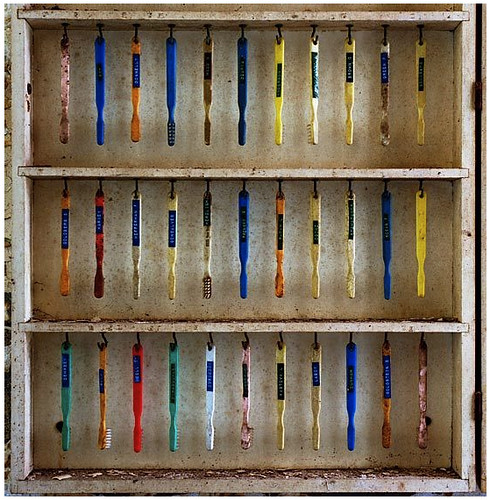
Jeremy Harris Photography
Found at BoingBoing.
This photograph may be the most compelling image of coercion in mental health ever created.
As long as we continue to give the "mentally ill" shots and pills instead of diagnosing and correcting what is really wrong - mostly deficiencies, allergies, toxic overloads and infections - we are STILL THERE, in the asylums, and our "treatment" is a sham. Read about how to get proper diagnosis and a return to health here
Restraint and seclusion still occur today
Wednesday, April 2, 2008
Reader's Digest: FDA is America's Next Katrina

NEXT? It's already here.Nearly 800,000 people die from drug side effects every year. Deaths from vitamins: None.
Read this report on the FDA from the ultra-conservative READER"S DIGEST here
Subscribe to:
Posts (Atom)


 Posts
Posts