From THE ATLANTIC magazine
The Drug Pushers
"As America turns its health-care system over to the market, pharmaceutical reps are wielding more and more influence—and the line between them and doctors is beginning to blur
By CARL ELLIOTT
Back in the old days, long before drug companies started making headlines in the business pages, doctors were routinely called upon by company representatives known as “detail men.” To “detail” a doctor is to give that doctor information about a company’s new drugs, with the aim of persuading the doctor to prescribe them. When I was growing up, in South Carolina in the 1970s, I would occasionally see detail men sitting patiently in the waiting room outside the office of my father, a family doctor. They were pretty easy to spot. Detail men were usually sober, conservatively dressed gentlemen who would not have looked out of place at the Presbyterian church across the street. Instead of Bibles or hymn books, though, they carried detail bags, which were filled with journal articles, drug samples, and branded knickknacks for the office.
Today detail men are officially known as “pharmaceutical sales representatives,” but everyone I know calls them “drug reps.” Drug reps are still easy to spot in a clinic or hospital, but for slightly different reasons. The most obvious is their appearance. It is probably fair to say that doctors, pharmacists, and medical-school professors are not generally admired for their good looks and fashion sense. Against this backdrop, the average drug rep looks like a supermodel, or maybe an A-list movie star. Drug reps today are often young, well groomed, and strikingly good-looking. Many are women. They are usually affable and sometimes very smart. Many give off a kind of glow, as if they had just emerged from a spa or salon. And they are always, hands down, the best-dressed people in the hospital.
Drug reps have been calling on doctors since the mid-nineteenth century, but during the past decade or so their numbers have increased dramatically. From 1996 to 2001 the pharmaceutical sales force in America doubled, to a total of 90,000 reps. One reason is simple: good reps move product. Detailing is expensive, but almost all practicing doctors see reps at least occasionally, and many doctors say they find reps useful. One study found that for drugs introduced after 1997 with revenues exceeding $200 million a year, the average return for each dollar spent on detailing was $10.29. That is an impressive figure. It is almost twice the return on investment in medical-journal advertising, and more than seven times the return on direct-to-consumer advertising.
But the relationship between doctors and drug reps has never been uncomplicated, for reasons that should be obvious. The first duty of doctors, at least in theory, is to their patients. Doctors must make prescribing decisions based on medical evidence and their own clinical judgment. Drug reps, in contrast, are salespeople. They swear no oaths, take care of no patients, and profess no high-minded ethical duties. Their job is to persuade doctors to prescribe their drugs. If reps are lucky, their drugs are good, the studies are clear, and their job is easy. But sometimes reps must persuade doctors to prescribe drugs that are marginally effective, exorbitantly expensive, difficult to administer, or even dangerously toxic. Reps that succeed are rewarded with bonuses or commissions. Reps that fail may find themselves unemployed.
Most people who work in health care, if they give drug reps any thought at all, regard them with mixed feelings. A handful avoid reps as if they were vampires, backing out of the room when they see one approaching. In their view, the best that can be said about reps is that they are a necessary by-product of a market economy. They view reps much as NBA players used to view Michael Jordan: as an awesome, powerful force that you can never really stop, only hope to control.
Yet many reps are so friendly, so easygoing, so much fun to flirt with that it is virtually impossible to demonize them. How can you demonize someone who brings you lunch and touches your arm and remembers your birthday and knows the names of all your children? After awhile even the most steel-willed doctors may look forward to visits by a rep, if only in the self-interested way that they look forward to the UPS truck pulling up in their driveway. A rep at the door means a delivery has arrived: take-out for the staff, trinkets for the kids, and, most indispensably, drug samples on the house. Although samples are the single largest marketing expense for the drug industry, they pay handsome dividends: doctors who accept samples of a drug are far more likely to prescribe that drug later on...."
Continues at Link
Showing posts with label marketing. Show all posts
Showing posts with label marketing. Show all posts
Saturday, June 20, 2009
Taking Down the Corporate Food System Is Simple

Taking Down the Corporate Food System Is Simple
By Joel Salatin, Public Affairs Books
Posted on June 20, 2009,
http://www.alternet.org/story/140477/
Excerpted by permission from "Declare Your Independence" by Joel Salatin, part of the book Food, Inc., available now from PublicAffairs. Copyright 2009.
Perhaps the most empowering concept in any paradigm-challenging movement is simply opting out. The opt-out strategy can humble the mightiest forces because it declares to one and all, "You do not control me."
The time has come for people who are ready to challenge the paradigm of factory-produced food and to return to a more natural, wholesome and sustainable way of eating (and living) to make that declaration to the powers that be, in business and government, that established the existing system and continue to prop it up. It's time to opt out and simply start eating better -- right here, right now.
Impractical? Idealistic? Utopian? Not really. As I'll explain, it's actually the most realistic and effective approach to transforming a system that is slowly but surely killing us.
What happened to food?
... snip...
The unprecedented variety of bar-coded packages in today's supermarket really does not mean that our generation enjoys better food options than our predecessors. These packages, by and large, having passed through the food-inspection fraternity, the industrial food fraternity and the lethargic cheap-food-purchasing consumer fraternity, represent an incredibly narrow choice.
Link

Author Joel Salatin at his farm


Wednesday, June 10, 2009
Disease Mongering
"Driving the annual double-digit growth in the legal drug supply are a band of specialist "healthcare" PR companies working for behemoths such as Pfizer, GlaxoSmithKline, Merck and Astra Zeneca. Heading the healthcare PR league table are Edelman, Ruder Finn and Chandler Chicco Agency in the US and Medical Action Communications, Shire Health Group and Meditech Media in the UK.
"Medical education" includes cultivating and deploying sponsored "key opinion leaders" such as doctors. Patient groups too can be created or wooed to assist with "disease awareness campaigns" or provide emotionally charged testimony in favor of speedy regulatory approval of new drugs.
Other lucrative revenue streams for healthcare PR companies can include organizing events such as medical conferences that provide a platform for well-trained "product champions" to announce promising results of drug research. Such results can be reported by medical journalists--who can be hired by PR firms--in medical journals that they can create for their clients."
Link
Sunday, May 10, 2009
Merck employee wants to search and destroy noncompliant doctors

A fascinating court case in Australia has been playing out around some people who had heart attacks after taking the Merck drug Vioxx. This medication turned out to increase the risk of heart attacks in people taking it, although that finding was arguably buried in their research, and Merck has paid out more than £2bn to 44,000 people in America – however, they deny any fault.
British users of the drug have had their application for legal aid rejected, incidentally: the health minister, Ivan Lewis, promised to help them, but documents obtained by the Guardian last week showed that within hours Merck launched an expensive lobbying effort that convinced the minister to back off.
This is a shame, because court cases can be tremendously revealing.
The first fun thing to emerge in the Australian case is email documentation showing staff at Merck made a "hit list" of doctors who were critical of the company, or of the drug. This list contained words such as "neutralise", "neutralised" and "discredit" next to the names of various doctors.
"We may need to seek them out and destroy them where they live," said one email, from a Merck employee. Staff are also alleged to have used other tactics, such as trying to interfere with academic appointments, and dropping hints about how funding to institutions might dry up. Institutions might think about whether they wish to receive money from a company like that in future. Worse still, is the revelation that Merck paid the publisher Elsevier to produce a publication.
The relationship between big pharma and publishers is perilous. Any industry with global revenues of $600bn can afford to buy quite a lot of adverts, and pharmaceutical companies also buy glossy expensive "reprints" of the trials it feels flattered by. As we noted in this column two months ago, there is evidence that all this money distorts editorial decisions.
Link
Sounds like the Mob, doesn't it? We wonder if physicians, after reading about these tactics, will not question the Pharma-funded education they have received - and the Merck manual itself.
Hat tip to MDE: Thank you.
Wednesday, March 11, 2009
Former Drug Rep on Manipulating Doctors
We applaud Gwen Olsen for her courage in coming forward with this information.
Tuesday, May 27, 2008
Video - Money Talks: Profit Before Patient Safety
This 50-minute documentary was created to give an in-depth, academic perspective on the questionable marketing tactics of the pharmaceutical industry, and features the commentary of investigative journalists and medical professionals including Dr. John Abramson, author of Overdosed America, and Prescription Access Litigation Project Director, Alex Sugerman-Brozan. Other notable interviewees include Dr. Bob Goodman of Columbia University, founder of the 'No Free Lunch' program, and Dr. Jerome Hoffman of UCLA Medical School.

But these day may be numbered. Pharma may soon have to disclose its contacts. Read more here.
Friday, March 7, 2008
Marketing Overdose Campaign
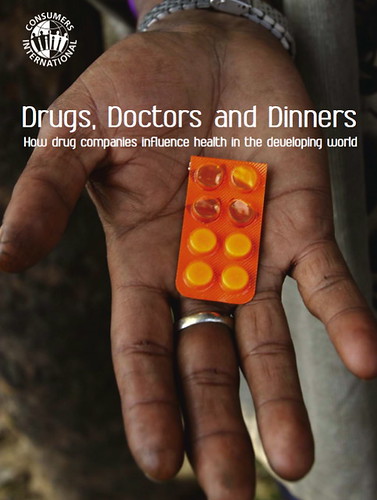
The pharmaceutical industry spends US$60 billion on drugs marketing each year, twice as much as it spends on research and development. Yet consumers know next to nothing about where this money is going. To expose where pharma companies spend this money, how it increases drugs sales, and why this irresponsible behaviour is putting consumer health at risk, Consumers International has produced a series of short, fun films for the Marketing Overdose campaign. Watch them - and get involved.
http://www.marketingoverdose.org/
Don't miss this expose of Pharma manipulation of physicians in Third World countries.
Drugs, Doctors and Dinners
Canada's Dr. Joel Lexchin weighs in on this
in the BMJ
Soft Targets: Nurses and the Pharmaceutical Industry

The pharmaceutical industry recognizes nursing influence on medical prescribing and identifies nurses as a marketing target. The industry has had its eye on nurses and nurse practitioners for over a decade, and is heavily invested in wooing them. The nursing literature has yet to pay much attention to the expansive reach of the pharmaceutical industry into the nursing profession. In this article, some of the key literature on the influence of drug companies upon nurses is examined.
Article here
Subscribe to:
Posts (Atom)


 Posts
Posts